EU Battery Passports: New Rules Open for Public Feedback
The European Commission is consulting on who can access restricted battery passport information, how it can be used and when it can be shared.
On 19 October 2026, the European Commission opened a public consultation on proposed rules governing access to digital battery passport information.
The proposal addresses a practical question: who should be allowed to access detailed product information, and what can they do with it?
The draft is open for feedback until 16 November 2026. It has not yet become law.
What Is Being Proposed?
Under the existing EU Batteries Regulation, digital passports will be mandatory from 18 February 2027 for electric vehicle batteries, light means of transport batteries (such as those used in e-bikes) and industrial batteries with a capacity greater than 2 kWh.
These passports will contain information about battery characteristics, performance, sustainability and lifecycle.
Not all that information will be publicly available. Some data is reserved for authorities, while other information is accessible only to organisations with a legitimate interest.
The latest proposal sets out which organisations can access certain restricted information and the conditions for using it.
Who Would Be Able to Access the Data?
The draft identifies several groups, including:
- Repairers and remanufacturers, who need technical information to assess and work on batteries.
- Recyclers and waste-treatment operators, who need information for safe treatment and recycling.
- Businesses repurposing batteries, who need to assess their suitability for further use.
- Battery purchasers, who may need information about an individual battery’s condition and remaining useful life.
- Specialist training centres, which need relevant information for repair and repurposing activities.
Access would depend on the organisation’s role and the particular information involved.
The draft also makes an important distinction between accessing information and sharing it.
Authorised users could download certain restricted data for specified activities, but generally could not publish or pass it on without permission. Exceptions would apply in particular circumstances, including sharing information with emergency services, poison centres and relevant authorities.
Specified safety information would be subject to broader sharing rights.
Why Is This Significant?
Digital product passports are intended to make product information useful beyond the initial sale.
Consider the difference between the information a customer needs and what a specialist might require.
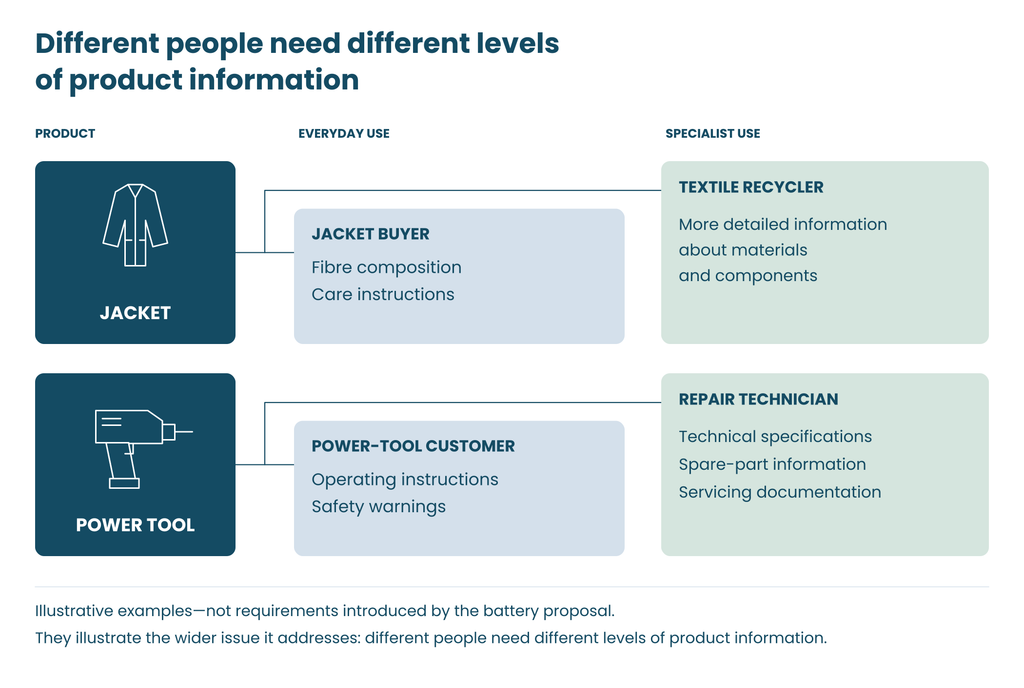
Someone buying a jacket needs fibre composition and care instructions. A textile recycler may need more than the fibre composition on a clothing label. Details of blended materials, chemical coatings, fastenings and how components can be separated help determine whether a garment can be recycled and which recycling process is suitable.
A customer using a power tool needs operating instructions and safety warnings. A repair technician may also need technical specifications, spare-part information and servicing documentation.
These examples are not requirements introduced by the battery proposal. They illustrate the wider issue it addresses: different people need different levels of product information.
The Commission’s broader Digital Product Passport framework is expected to extend progressively to additional product groups, including textiles and construction products. Their specific requirements will be determined through the relevant legislation.
What Happens Next?
The draft has been published through the European Commission’s Have Your Say portal, which allows businesses, industry associations and other interested parties to comment on proposed legislation.
The Commission is seeking feedback on whether the proposed access rights and restrictions are appropriate before finalising the rules.
Key dates:
- 19 October 2026: Public feedback opened.
- 16 November 2026: Feedback closes at midnight Brussels time.
- Fourth quarter 2026: Commission adoption planned.
- 18 February 2027: Existing battery passport requirement takes effect for the relevant battery categories.
The consultation does not introduce new digital passport obligations for other product categories.
However, it offers an early indication of how the EU intends to manage access to product information as digital passports become more widely used.
The key takeaway: Digital product passports are not simply about collecting more data. They also need to ensure that the right people can access and use the information they need, while protecting information that should remain restricted.
Have Your Say
Businesses and industry organisations can review the draft regulation and submit feedback directly through the European Commission’s consultation portal.
Read the proposal and submit feedback — European Commission Have Your Say
Source: European Commission draft Implementing Regulation, Ref. Ares(2026)9814179, published 19 October 2026. This is a proposal, not adopted legislation.