The Cost of Uncertainty: What the Latest Egg Recall Reveals About Ready-Meal Traceability
Last week’s FSA egg recall highlights why better batch traceability could save food manufacturers money – and where QR codes could help.
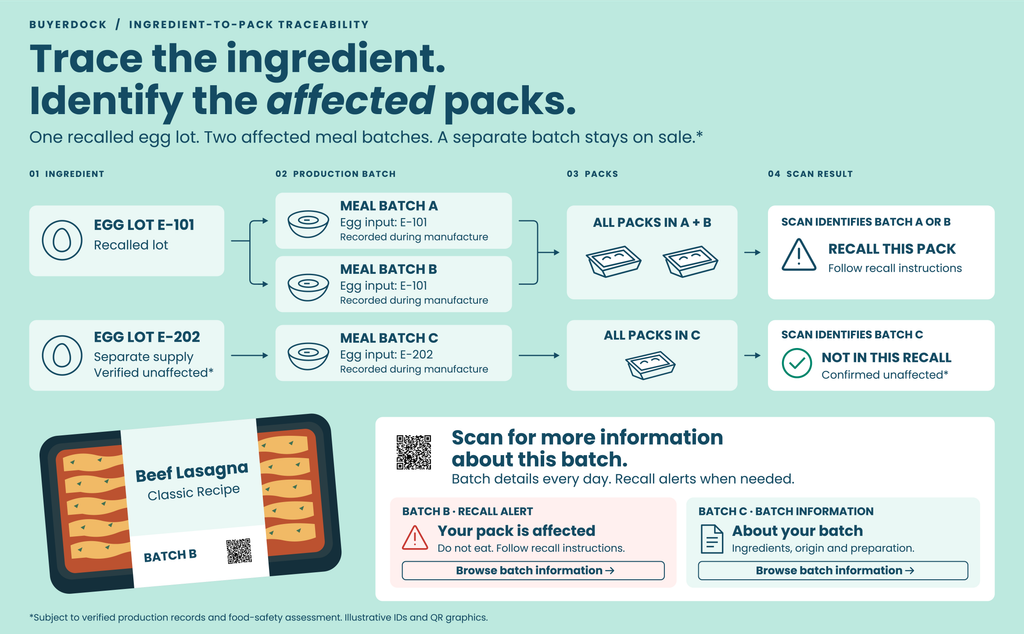
The recent Food Standards Agency (FSA) alert involving eggs imported from Ukraine raises a question for ready-meal manufacturers: what happens when one affected ingredient has been used across several products and production batches?
Eggs can be found in quiches, pasta dishes, prepared salads and other ready meals. If a supplier identifies a contamination risk, manufacturers must establish which finished products contain the affected ingredient.
Where records clearly link ingredient lots to finished-product batches, a manufacturer may be able to isolate the products at risk. Where those links are uncertain, a wider precautionary withdrawal or recall may be necessary.
And that uncertainty can be expensive.
The Financial Cost of a Wider Recall
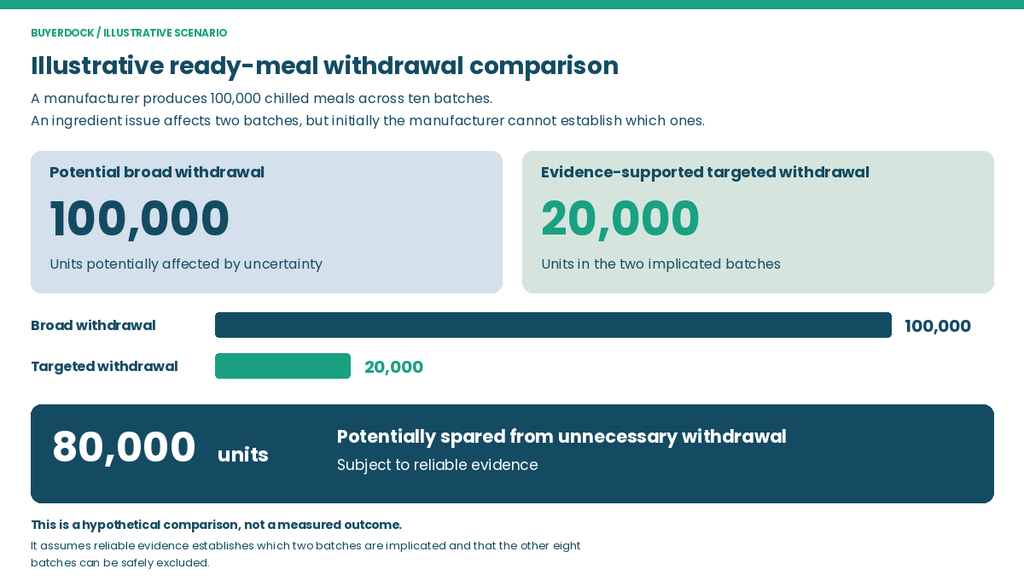
Imagine a manufacturer produces 100,000 ready meals across ten batches. A safety issue affects an ingredient used in just two batches, representing 20,000 meals.
If the manufacturer cannot confidently identify those batches, it may need to withdraw all 100,000 products while investigating.
But if reliable traceability records establish that the remaining eight batches are unaffected, the recall could potentially be limited to 20,000 meals.
That’s 80,000 products potentially spared from unnecessary withdrawal.
At an illustrative loss of £2.50 per meal, the difference is £200,000 in product losses alone – before considering transport, disposal, retailer administration and disruption to sales.
These figures are hypothetical. Any decision to exclude batches must be supported by reliable records and an appropriate food safety assessment.
Where Do Batch-Level QR Codes Fit?
Ready-meal manufacturers already use printed lot codes and maintain traceability records. A QR code doesn’t replace those systems or determine which products are safe.
Its value is in connecting the physical pack to current information about its specific batch.
Imagine a consumer has two identical ready meals in the fridge, purchased on different days. One batch has been recalled; the other has not.
Rather than searching for a recall notice and manually comparing small printed codes, the consumer could scan a batch-specific QR code.
An affected pack could display a clear recall warning and instructions. An unaffected pack could continue showing normal product information, provided the manufacturer has verified its status.
The distinction matters:
Ingredient traceability helps a manufacturer identify what needs recalling. Batch-level QR codes could help communicate that decision quickly and clearly.
Beyond the Batch Code
For ready-meal brands, the financial impact of a recall isn’t just about how many products are affected. It’s also about how confidently they can identify the ones that aren’t.
Accurate ingredient-to-batch traceability can help avoid unnecessary withdrawals. Batch-level QR codes add another layer, connecting each pack to up-to-date product information, including recall instructions when needed.
Buyerdock is already exploring this approach through pilots with industry leaders, building on our earlier work in connected packaging. If you’re exploring how this could work for your products, let’s have a chat.