Retail Barcode Revolution: What GS1 Sunrise 2027 Means for Packaging.
Since the first retail barcode scan more than 50 years ago, the familiar pattern of black lines has helped shops identify products quickly and reliably. Packaging has changed around it, but the barcode’s main job has remained the same: carry a number that tells the checkout what is being sold.
Now a retail barcode revolution is taking shape. Under GS1’s Sunrise 2027 initiative, the goal is for retail checkouts to read and process GS1-standard two-dimensional (2D) barcodes alongside traditional ones by the end of 2027. These codes can support product identification, additional data and connections to information online.
For brands, this creates an opportunity to make packaging more useful throughout a product’s life. It also raises practical questions: which code should go on the pack, what information should sit behind it, and when can the existing barcode be removed?
The transition is already reaching supermarket shelves
Tesco has introduced QR codes powered by GS1 across its own-label core sausage range, replacing traditional linear barcodes.
For brands selling through Tesco, that is a reason to start preparing now. It does not establish a requirement for every supplier to switch immediately, but it shows that 2D barcodes are moving beyond trials into everyday retail use.
The useful next step is to ask your retailer about its plans, scanning requirements and expectations for suppliers. That conversation can inform your next packaging update, giving you time to prepare the code and product data before artwork reaches the printer.
What does Sunrise 2027 mean for brands?
The central ambition is checkout readiness: retail systems should be able to extract and process the product identifier from supported GS1-standard 2D barcodes.
That first step does not require every brand to introduce every possible feature at once. A retailer may initially use a code for product identification, then develop additional uses for batch numbers or expiry dates. A brand may begin by connecting customers to a product page before adding instructions, recycling guidance or other content.
Several 2D formats can support retail applications. A QR code using GS1 Digital Link is particularly relevant to consumer-facing packaging because it can carry the product’s identity and connect a smartphone scan to online information.
An ordinary QR code pointing to a website does not automatically provide the standardised identification needed at checkout.
| Common misconception | What brands need to know |
|---|---|
| Every linear barcode must disappear in 2027. | The ambition is for checkouts to support GS1-standard 2D barcodes alongside existing linear barcodes. Any removal should be agreed with retailers. |
| Any QR code will work at checkout. | Retail scanning requires the appropriate GS1 format and product identifiers, supported by the retailer’s systems. |
| All 2D barcode features must be ready by 2027. | Brands and retailers can introduce capabilities progressively, starting with product identification. |
| Adding a code completes the transition. | Accurate data, suitable printing, scanning tests and ongoing content management are also part of implementation. |
| Sunrise 2027 means every product needs a Digital Product Passport. | Retail barcode readiness and Digital Product Passport requirements are separate developments, although they can share an identification and linking foundation. |
What changes for the pack?
Many packs currently carry one barcode for checkout and another QR code for customer information. As checkout systems become 2D-ready, a GS1 Digital Link QR code can potentially serve both purposes: identify the product at the till and take customers to ingredients, instructions, recycling guidance or other information online.
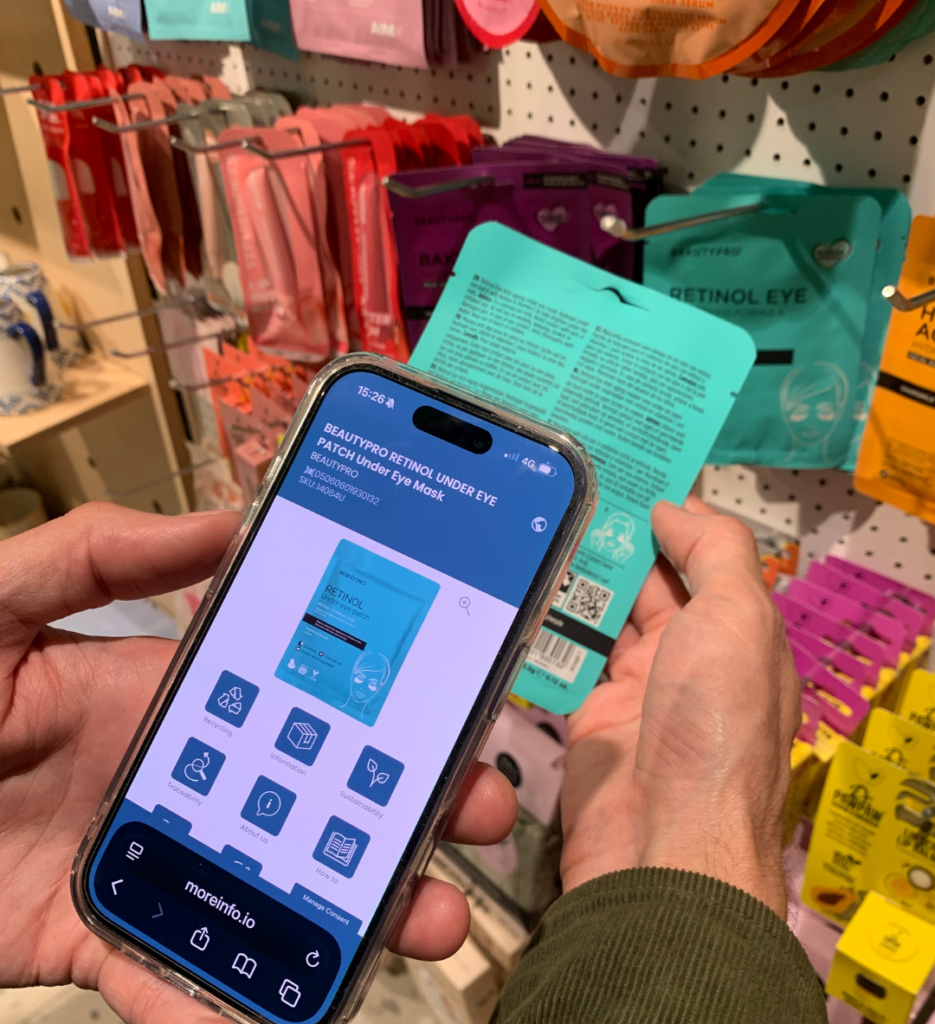
BeautyPro packaging in Oliver Bonas displays both a linear barcode and an iQRcode™.
This gives brands more flexibility over the information they share. The printed code can remain on the pack while the online content is maintained, allowing guidance and links to evolve without changing the packaging artwork.
At Buyerdock, that is the idea behind iQRcode™. We use GS1 Digital Link to connect packaging to product information that brands can manage online, making the code part of an ongoing product information strategy rather than a one-off campaign.
DUO eyelash adhesives show what this can look like in practice. DUO uses our iQRcode™ to provide country-specific recycling information and how-to guidance. Our case study reports that the code appears on more than 15 million products across 105 countries, helping the brand maintain a consistent packaging design across markets.
The how-to section became the most-used feature. Through our platform’s engagement analytics, DUO could see which information customers valued most and use that insight to improve its content. Connected packaging can therefore help brands answer practical questions after purchase and understand how customers use the information provided.
Plan around your packaging refresh
A packaging update is an opportunity to introduce a 2D code, but the decision involves more than finding space for another symbol.
Design, product data, print production and retail teams need to agree what the code will contain and how it will be used. A code linked to a product’s GTIN (Global Trade Item Number) can be part of standard artwork. Including batch or expiry information may require the code to be generated and printed during production, when those details are known.
Testing should use the actual packaging wherever possible. Size, contrast, placement, material and the way a pack folds or curves can affect scanning. A code that works on a screen should still be checked on the finished pack and in the intended checkout environment.
Where linear and 2D barcodes appear together, their layout should follow GS1 guidance and retailer requirements. Addressing these questions before artwork approval can reduce the risk of having to revise a newly printed pack.
How does this connect to Digital Product Passports?
A GS1 Digital Link QR code can provide an access point to a Digital Product Passport, connecting the physical product to its digital information.
That makes the barcode transition a useful time to organise product data. Brands can establish product identity and customer information, then build out materials, traceability, supporting documents, repair guidance and end-of-life instructions as needed.
At Buyerdock, we help brands develop that information progressively behind their iQRcode™. However, generating a code does not by itself create a complete or compliant Digital Product Passport. The required information and systems depend on the rules that apply to the product.
The same principle applies to packaging content: online information can extend the label, while information legally required on the physical pack must remain there.
Start with one product and a clear purpose
Choose a product with an upcoming packaging refresh and a useful customer information need. Confirm its identifier, speak to the retailer and decide what a customer should find after scanning.
Assign responsibility for maintaining that information. Instructions, links and recycling guidance need an owner, just as printed packaging copy does.
Then test the code on the finished packaging before expanding across the range. Customer engagement data can help you improve the online experience as you go.
Starting early gives brands time to make these decisions as part of normal packaging development. With our iQRcode™, you can begin with the information you already have and build on it over time.
Explore iQRcode™ and start connecting your packaging to product information.