Seen On Shelves: Rockit Rocker Using iQRcode™ at John Lewis
Another iQRcode™ spotted on shelves — this time on Rockit Rocker at John Lewis.
For this edition of #SeenOnShelves, we spotted the Rockit Rocker Rechargeable Version at John Lewis and scanned its iQRcode™ to see what sits behind the physical product.
One scan connects the customer to a digital product experience containing useful information that doesn’t have to compete for space on the packaging.
And that’s what makes this example interesting. iQRcode™ isn’t being used for just one purpose. It connects the product with information that can support the customer, recycling and packaging compliance, while creating a digital connection that can continue beyond the point of purchase.
What happens when you scan?
Scanning the iQRcode™ connects the physical Rockit Rocker with its digital product information.
The experience provides access to areas including:
- Product information
- How-to guidance
- FAQs
- Recycling information
- Information about the company
The digital experience also includes product identifiers such as the GTIN and SKU, helping connect the physical product with the correct digital information.
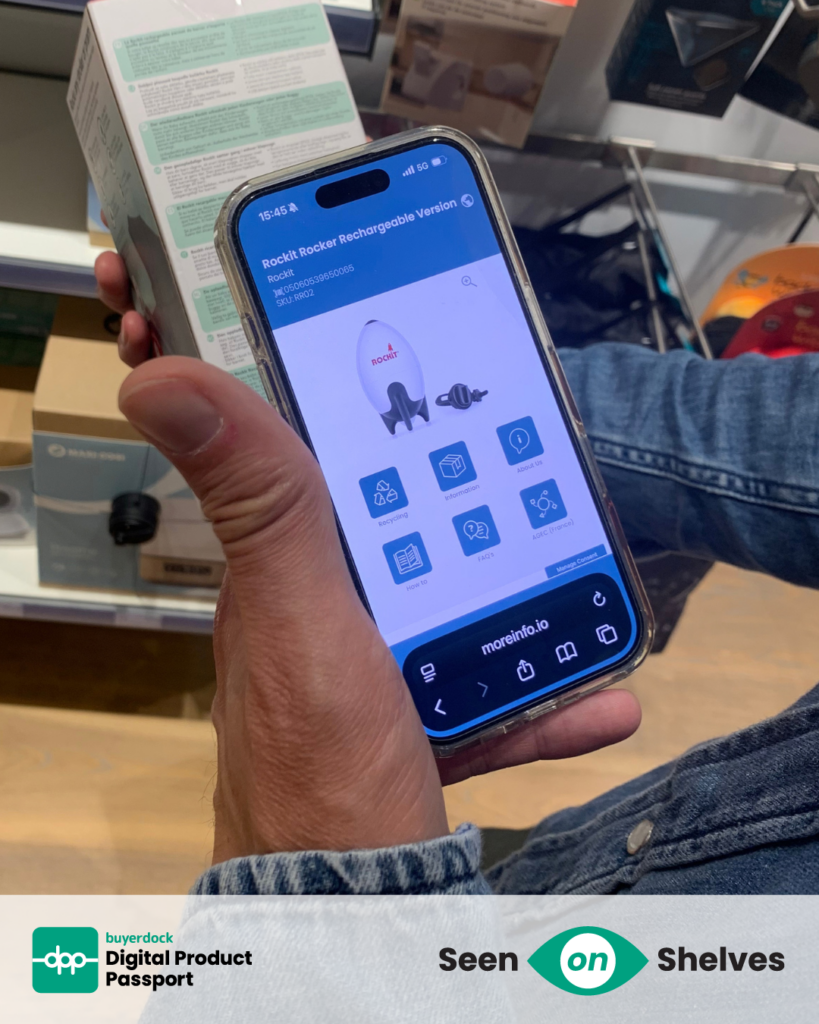
It’s a simple interaction for the customer.
See the iQRcode™. Scan. Access the information.
Behind that simple interaction, however, sits structured product information that can be used for several different purposes.
Taking product information beyond the pack
Packaging has limited space.
Product information doesn’t.
Brands need to communicate instructions, recycling information, regulatory information, product details and other useful content — all while leaving enough space for the packaging to actually do its job as packaging.
iQRcode™ provides another information layer.
Instead of trying to fit everything onto the physical pack, information can be connected digitally to the product and made available when someone needs it.
For Rockit Rocker, that means the product can provide much more information than you can see when it’s sitting on the shelf.
Supporting packaging compliance too
There’s also a less visible but important role for the digital information behind the iQRcode™: packaging compliance.
Brands selling across Europe can face different packaging and recycling-information requirements in different markets.
For example, France uses the Triman and Info-tri system, providing consumers with sorting information for products and packaging covered by the relevant requirements. Italy has its own environmental packaging labelling requirements, including information relating to packaging materials and collection. Digital channels can play a role in providing this information where the applicable rules permit it.
So “European packaging compliance” isn’t one generic recycling message.
The information required can depend on the market, the product and the packaging materials involved.
For a brand such as Rockit Rocker, iQRcode™ provides a way to connect the physical product with relevant digital information without treating the physical pack as the only place that information can live.
That’s a useful compliance application — but it’s only one part of what the digital connection can do.
The important part happens after the scan
Putting an iQRcode™ on the packaging is the visible part.
What really matters is what someone finds after they scan it.
A scan that simply takes somebody to a corporate homepage isn’t particularly useful.
A scan connected to the actual product can be.
For Rockit Rocker, the digital experience gives customers access to information relevant to the product in their hand — whether they’re looking for product details, instructions, answers to common questions or recycling information.
That changes the question brands should be asking.
Not simply:
“How do we put an iQRcode™ on our packaging?”
But:
“What could we make available to someone once our product is digitally connected?”
One connection, more than one purpose
This is where connected products become particularly interesting.
The same iQRcode™ can potentially support different needs at different points in the product journey.
Before purchase:
A shopper can access additional product information.
After purchase:
The customer can return for instructions, FAQs and support.
At end of life:
Recycling and disposal information can be available when it becomes relevant.
For different markets:
Relevant packaging and recycling compliance information can be made available according to the requirements that apply.
The physical product hasn’t changed.
The information available around it has.
What can brands learn from Rockit Rocker?
There are four useful questions to take from this #SeenOnShelves example.
1. Is the product correctly identified?
The digital experience needs to know which product has been scanned.
Identifiers such as the GTIN help connect the physical item with the appropriate digital product information.
2. Is the information behind it useful?
Give people a reason to scan.
Instructions, FAQs, recycling guidance, detailed product information and support are much more useful than simply directing everyone to a generic website.
3. What information could move beyond the physical pack?
Look at what is currently competing for space on your packaging.
That might include consumer information, recycling guidance or market-specific compliance information such as Triman/Info-tri.
Some information must still appear physically under applicable rules, so digital shouldn’t automatically be treated as a replacement for on-pack information. But it can provide a valuable additional layer.
4. Is the product data behind the experience ready?
This is the part that’s easy to overlook.
The experience is only as useful as the information sitting behind it.
Products need to be identified correctly. Product and packaging data needs to be accurate. And that information needs to be structured and managed so that the appropriate information can be connected to the appropriate product.
What does this have to do with Digital Product Passports?
There’s a natural connection here, but an important distinction too.
iQRcode™ provides the digital entry point. It isn’t, by itself, the Digital Product Passport.
Digital Product Passports depend on the product’s identity, required information, accessibility and the data infrastructure sitting behind the physical connection.
That’s why examples like Rockit Rocker are useful for businesses thinking about DPP readiness.
They demonstrate some of the underlying behaviours in the real world:
physical product → iQRcode™ → identified product → digital information
And brands don’t have to wait for future DPP obligations before that infrastructure becomes useful.
It can solve problems now — from giving customers better information to supporting recycling guidance and packaging compliance.
From packaging to a connected product
That’s what caught our attention when we found Rockit Rocker at John Lewis.
At first glance, it’s simply a product sitting on a retail shelf.
Scan its iQRcode™, however, and the physical product becomes the entry point to a much larger digital information experience.
Product information. How-to guidance. FAQs. Recycling information. Packaging compliance.
All connected to the physical product through iQRcode™.
That’s a much better way to think about connected packaging:
not how much information can we fit on the pack, but how much useful information can we connect to the product?
And we’ll keep looking for examples already doing it.
Continue your DPP readiness journey
Your DPP Is Only as Good as Your Product Data
Why structured, identifiable and interoperable product information matters when preparing for Digital Product Passports.
Q&A: Where Do I Start With DPP?
A practical starting point for businesses beginning their DPP journey.
5 Key Takeaways from the European Commission’s Updated PPWR FAQs
Explore the changing European packaging landscape and what businesses need to consider.
About #SeenOnShelves
#SeenOnShelves is Buyerdock’s ongoing look at iQRcode™ and connected product experiences already appearing in real-world retail.
We find them, scan them and explore what sits behind the physical product — from useful consumer information and recycling guidance to compliance and Digital Product Passport readiness.