Circular Supply Chains Are Getting Real: Key Insights from the February Circular Economy Exchange
Our latest Circular Economy Exchange roundtable led by Positive Luxury, brought together brands, suppliers, technology providers, academics, and standards organisations to discuss one question:
How do we make circular supply chains work in practice – not just in theory?
The conversation revealed a clear reality: while ambition is high, execution remains complex. But progress is happening – and the path forward is becoming clearer.
This article explores the key insights from the exchange and what they mean for brands preparing for regulatory change and Digital Product Passport (DPP) adoption.

The Biggest Barrier? Supplier Data – Not Supplier Willingnes
One of the strongest themes from the discussion was supplier engagement.
Brands are increasingly requesting ESG and lifecycle data, but suppliers often struggle to provide it – not because they resist sustainability, but because systems and processes are fragmented.
Participants highlighted several recurring pain points:
- ESG questionnaires sent without audits or support
- Over 450 sustainability accreditations creating confusion
- Time-intensive lifecycle assessments requested on demand
- Lack of centralised data repositories across supplier tiers
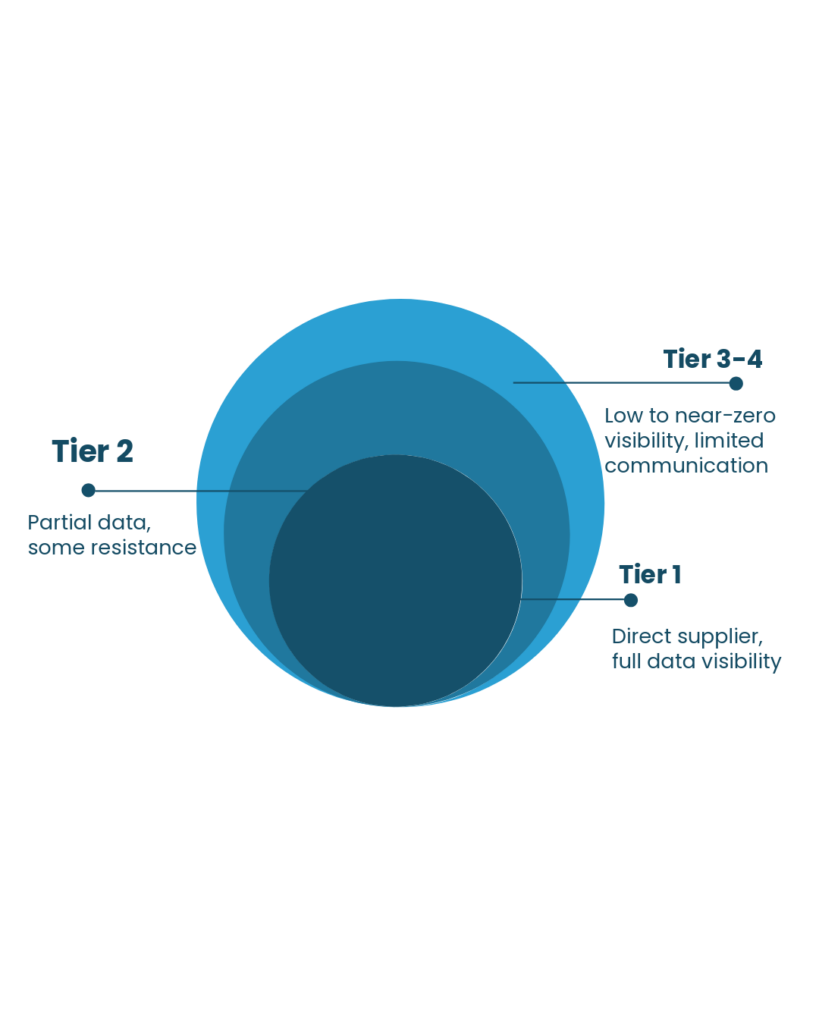
Beyond Tier-1 suppliers (direct suppliers to brands), visibility drops dramatically. By Tier-3 and Tier-4, further upstream in the supply chain, data access can approach zero, making compliance reporting – particularly for packaging and EPR – significantly harder.
The key insight?
Suppliers engage when compliance becomes easy and commercially valuable.
Embedding data capture into existing workflows – even tools like WeChat – dramatically increases participation.
Circularity Meets Commercial Reality
The roundtable also explored the tension between sustainability ambition and business constraints.
Several practical challenges emerged:
- Local circular loops are difficult when manufacturing is globalised
- Upcycling and remaking haven’t scaled operationally
- Zero-waste manufacturing remains aspirational
- Higher recycled content can reduce durability
This last point is particularly important. Brands are navigating a complex trade-off between environmental goals, product performance, and customer expectations – especially with price-sensitive consumers who say they care but don’t always buy accordingly.
Circularity, in other words, is not just a technical problem. It’s a market behaviour problem.
Design Is Still the Biggest Lever
A widely cited statistic during the session was that 80% of a product’s environmental impact is determined at the design stage.

This reinforces a critical shift:
Circularity cannot be retrofitted.
Instead, brands need to:
- Embed circular principles into product design from the start
- Align procurement KPIs with sustainability outcomes
- Incentivise buyers to source circular materials
- Reduce SKU proliferation that undermines sustainability progress
When design and procurement teams share accountability, circularity moves from aspiration to operational reality.
Platforms and Standardisation: The Turning Point
Another major theme was duplication across supply chains.
Suppliers often repeat the same compliance processes for multiple clients, while brands repeatedly recollect data due to product changes between order and delivery.
The solution discussed repeatedly was shared platforms and interoperable data standards.
Moving away from spreadsheets and emails toward unified systems covering Tier-1 to Tier-3 suppliers – including trims and packaging – reduces friction, errors, and revalidation costs.
Even more importantly, real-time visibility changes behaviour.
When suppliers understand brand sustainability goals clearly, they begin proposing better materials and processes proactively – shifting relationships from compliance to collaboration.
Digital Product Passports: Start Now, Not Later
With EU Digital Product Passports expected to become mandatory by 2030 and regulatory complexity increasing across jurisdictions, waiting is no longer a viable strategy.
The roundtable highlighted several practical starting points:
- Use GS1 identifiers as the backbone for interoperability
- Convert barcodes to QR codes during production lead times
- Capture data once and reuse it across compliance and consumer use cases
- Localise consumer content – recycling guidance, usage, repair – rather than relying only on traceability
Regulations are accelerating, including EPR deadlines, recycling labelling requirements in multiple EU countries, and Ecodesign rules.
Brands that build standardised data infrastructure now will be significantly better positioned later.
The Most Important Takeaway: Progress Over Perfection
Perhaps the most encouraging conclusion from the session was this:
You don’t need a perfect system to start.
Organisations that begin with core data capture, standardisation, and supplier engagement can iterate over time.
Those that wait for clarity risk falling behind.
Circular supply chains are no longer theoretical, they are becoming operational, regulatory, and commercial realities.
The question is no longer if change is coming.
It’s how prepared you are when it arrives.
Next Event
Location: St. Annes Church [Allen Room 1st floor], 55 Dean Street, London. W1D 6AF
Date: 11th March 2026
Time: 2:15pm- 4:15pm
L
Topic: White Paper Review
RSVP here.