Why the Right QR Barcode Unlocks the Roadmap to DPP
23 March 2026
Author Sylviein DPPin iQRcode™
Digital Product Passports (DPPs) are fast becoming a board-level priority. Regulation is approaching and companies selling directly to consumers are all trying to determine the right approach without locking themselves into the wrong solution.
The challenge isn’t whether to act – it’s how to start, where to begin, and how to follow a clear, resilient roadmap as rules, categories, and expectations continue to evolve.
That uncertainty is exactly where a modular, infrastructure-first approach comes into its own.
From “build a DPP” to “build DPP-ready infrastructure”
Much of the current conversation still frames DPP as a single project: choose a vendor, connect some data, launch passports for one category.
The risk with that approach is straightforward. If requirements change, or if DPP obligations expand into new categories, brands can quickly find themselves tied to systems that only work for part of their portfolio.
A more durable method separates infrastructure from regulation and category.
Rather than being a one-off project, DPP becomes part of a broader foundation that supports how the business manages products and compliance overall – the same QR code remains on the product, while the information it reveals can adapt by product type, market, or regulation over time.
This shift, from building a DPP to building DPP-ready infrastructure is the core principle behind Buyerdock.
Why Buyerdock is modular by design
Buyerdock is built on a simple idea: brands don’t need a “DPP system” for one category alone – they need a product-level approach to compliance and communication that works consistently at every point a product is scanned.
Products are no longer just items on a shelf; they are narratives of origin, responsibility, and impact.
The real challenge is not collecting this information in isolation, but consolidating it in a way that scales across categories and regulations.
This is where modularity matters.
Compliance infrastructure, not a single-regulation tool
Buyerdock is designed to support multiple regulatory requirements from one foundation – not just a single interpretation of Digital Product Passports.
As new obligations emerge, whether under ESPR or future labelling and producer responsibility rules, brands do not need to rebuild their systems each time.
A staged approach to DPP at your pace
A modular model allows brands to move forward without overcommitting. Instead of launching a large, single-category DPP programme upfront, they can begin by putting a consistent QR foundation in place across their products.
The 2D barcode/ iQRcode™ unlocks the path to DPP. What it displays, compliance data, product information, circular journeys – can evolve over time without changing packaging or rebuilding infrastructure.
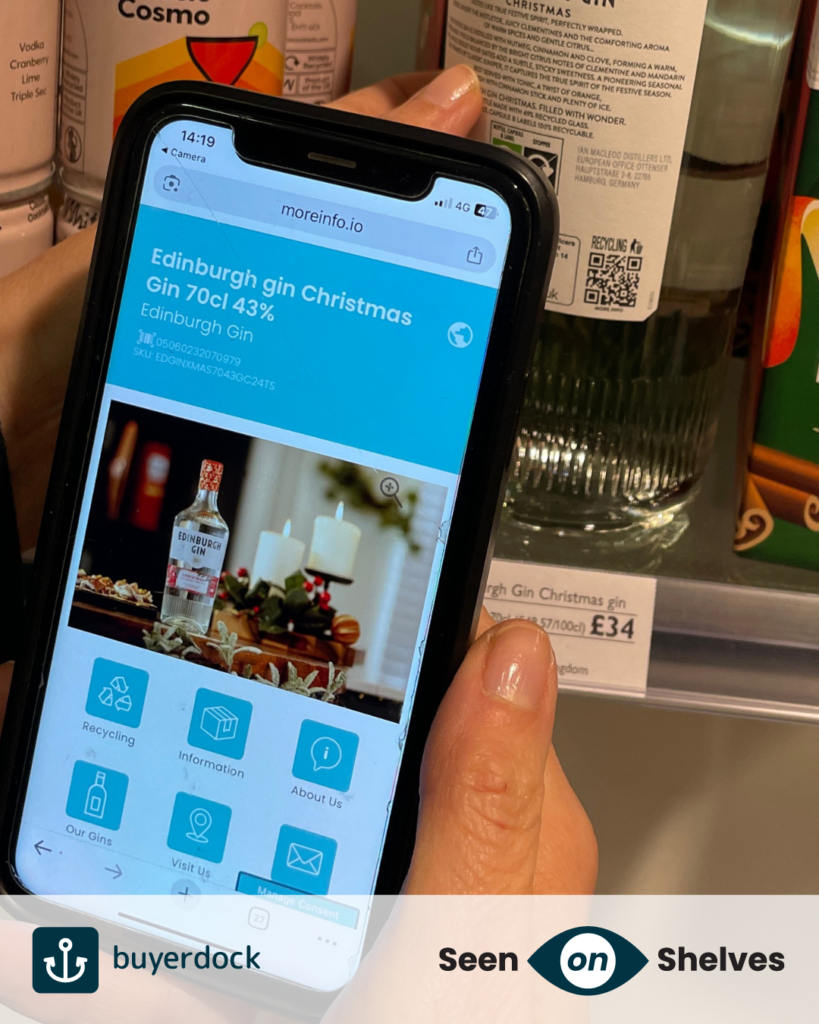
From there, depth can be added progressively. As internal teams and specialist partners come into play, richer product information can be layered behind the same code across categories. This was the strategy adopted by Edinburgh Gin who seized the opportunity for additional seasonal marketing last Christmas.
With the right foundation in place, brands are free to concentrate on strategy and test consumer engagement on selected products, rather than waiting for every DPP detail to be finalised.
Deeper passport requirements can then be activated as and when they become relevant with the support of Buyerdock’s ecosystem of specialist partners, this approach allows progress without over-committing too early.
When rules settle, it is the experience that adapts not the platform.
A modular approach reduces the key risks brands face when preparing for DPP
This strategy directly addresses the questions brands raise most often.
-> What if we build the wrong thing? Because both the data model and front-end experience can be updated centrally, brands aren’t locked into a single interpretation of today’s draft requirements.
-> How do we avoid fragmented data and duplicated work? A centralised, brand-controlled platform keeps product and compliance data in one place. From there, the same information can be presented through different category and regulation-specific views, without duplication or loss of control.
-> Can we afford this across our whole catalogue? A staged rollout allows brands to start with priority lines, for example, garments sold in Europe and expand only when the regulatory or commercial case is clear.
Investment is incremental: a lightweight foundation first, with deeper capability added where it delivers value.
It is worth noting that cost remains one of the most cited barriers to DPP adoption. Industry research consistently shows that around 40% of brands hesitate primarily due to concerns about cost and complexity.
As Kevin Dixie, Co-Founder of Buyerdock, puts it:
“Around 40% of brands hesitate to adopt Digital Product Passports due to cost. That’s why a gradual, cost-effective rollout matters.”
Many brands are already making early decisions that will prove expensive to undo. Some deploying a single, generic QR code that links to an entire website; an approach that will not meet emerging legislative or industry requirements.
As compliance rules tighten across Europe, North America, and Asia-Pacific, these shortcuts will become increasingly costly to unwind.
Buyerdock uses GS1-compliant QR codes from day one, helping brands avoid early missteps and build a clear roadmap to full compliance as requirements evolve.
To provide the best experiences, we use technologies like cookies to store and/or access device information. Consenting to these technologies will allow us to process data such as browsing behaviour or unique IDs on this site. Not consenting or withdrawing consent, may adversely affect certain features and functions.
Functional
Always active
The technical storage or access is strictly necessary for the legitimate purpose of enabling the use of a specific service explicitly requested by the subscriber or user, or for the sole purpose of carrying out the transmission of a communication over an electronic communications network.
Preferences
The technical storage or access is necessary for the legitimate purpose of storing preferences that are not requested by the subscriber or user.
Statistics
The technical storage or access that is used exclusively for statistical purposes.The technical storage or access that is used exclusively for anonymous statistical purposes. Without a subpoena, voluntary compliance on the part of your Internet Service Provider, or additional records from a third party, information stored or retrieved for this purpose alone cannot usually be used to identify you.
Marketing
The technical storage or access is required to create user profiles to send advertising, or to track the user on a website or across several websites for similar marketing purposes.
To provide the best experiences, we use technologies like cookies to store and/or access device information. Consenting to these technologies will allow us to process data such as browsing behaviour or unique IDs on this site. Not consenting or withdrawing consent, may adversely affect certain features and functions.
Functional
Always active
The technical storage or access is strictly necessary for the legitimate purpose of enabling the use of a specific service explicitly requested by the subscriber or user, or for the sole purpose of carrying out the transmission of a communication over an electronic communications network.
Preferences
The technical storage or access is necessary for the legitimate purpose of storing preferences that are not requested by the subscriber or user.
Statistics
The technical storage or access that is used exclusively for statistical purposes.The technical storage or access that is used exclusively for anonymous statistical purposes. Without a subpoena, voluntary compliance on the part of your Internet Service Provider, or additional records from a third party, information stored or retrieved for this purpose alone cannot usually be used to identify you.
Marketing
The technical storage or access is required to create user profiles to send advertising, or to track the user on a website or across several websites for similar marketing purposes.