What the Latest EUDR Updates Can Teach Brands About Digital Product Passports
The European Commission’s latest updates to the EU Deforestation Regulation (EUDR) have been welcomed by many businesses.
The changes include:
- The removal of cattle leather from scope through a draft Delegated Act.
- Simplified due diligence for sourcing from low-risk countries.
- Reduced obligations for many downstream operators under Regulation (EU) 2025/2650.
- Updates to the EUDR Information System, Guidance and FAQs.
For brands affected by EUDR, these changes may reduce some administrative burden. But at the same time, they also highlight a challenge that extends far beyond deforestation compliance.
Even when reporting obligations change, businesses still need to manage information.
-> Supplier declarations.
-> Traceability records.
-> DDS reference numbers.
-> Sourcing information.
-> Supporting compliance documentation.
The process may evolve, but the information remains. And that is a challenge many brands are already facing across multiple regulations.
The Product Information Challenge Brands Already Have
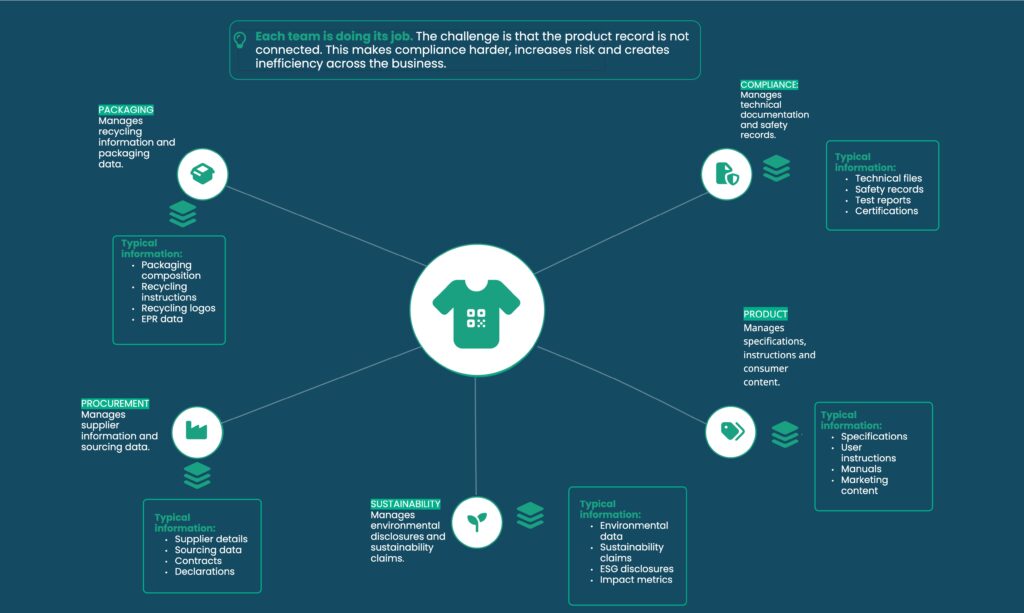
Most organisations do not manage product information in one place, that information is often distributed across teams and systems.
-> Compliance teams manage technical documentation and safety records.
-> Procurement teams manage supplier information and sourcing data.
-> Sustainability teams manage environmental disclosures and claims.
-> Packaging teams manage recycling information.
-> Product teams manage specifications, instructions and consumer content.
Each team is doing its job. The product sits at the centre of all of it and as regulations evolve, more information becomes associated with the same product, and it is rarely managed as a complete product record.
EUDR Is Not an Isolated Example
Many brands are already dealing with product information requirements across multiple regulations. They require different information but they often touch related aspects of the same product.
For example:
| Information | EUDR | GPSR | AGEC | DPP |
|---|---|---|---|---|
| Product identification | ✓ | ✓ | ✓ | ✓ |
| Traceability information | ✓ | ✓ | ✓ | |
| Supplier information | ✓ | ✓ | ||
| Safety information | ✓ | ✓ | ||
| Sustainability information | ✓ | ✓ | ||
| Consumer-facing information | ✓ | ✓ | ✓ |
As a result, many organisations find themselves running separate compliance projects while dealing with the same underlying challenge.
What Digital Product Passports Are Really Exposing
One of the biggest misconceptions about Digital Product Passports is that they create an entirely new problem but in reality, they expose an existing one.
Most businesses already hold much of the information that consumers, regulators, retailers and supply chain partners increasingly want access to.
The challenge is that the information is fragmented, stored in different systems, owned by different teams, updated through different processes.
Digital Product Passports force businesses to ask a simple question: If all of this information relates to the same product, why is it managed in so many different places?
That question is often more important than the DPP itself.
A Practical Exercise for Brands
If your business is discussing Digital Product Passports, start with a simple audit.
Pick one product.
Then identify:
How updates are managed.
Where product safety information is stored.
Where supplier information is stored.
Where sustainability disclosures are managed.
Where recycling information is maintained.
Where technical documentation is held.
Who owns traceability information.
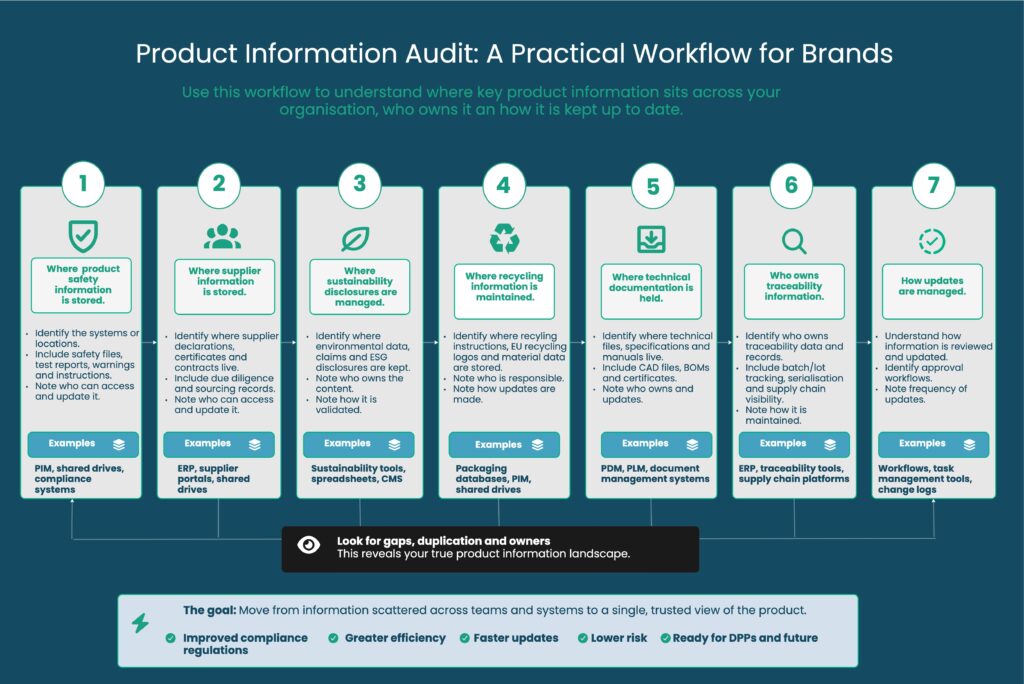
Many organisations discover that information relating to a single product exists across multiple systems, teams and workflows.
This is often the real barrier to DPP readiness.
Not missing information but relying on fragmented information.
What This Looks Like in Practice
For many brands, these challenges can feel theoretical until they are faced with the reality of managing product information at scale.
Vivobarefoot’s experience highlights a challenge that many growing brands face: managing product information consistently across large product portfolios while responding to evolving regulatory requirements.
They needed to manage more than 30,000 SKUs across its mainline and ReVivo product ranges while supporting GPSR requirements, French AGEC obligations, country-specific compliance information, and of course future Digital Product Passport readiness.
This was not simply a compliance exercise. Product information existed across thousands of products, multiple markets, legacy product lines, and different regulatory requirements. At the same time, packaging deadlines meant there was little room for error.
The challenge was not collecting more information. It was structuring, managing and delivering existing information consistently across a large and complex product portfolio.
That is a challenge many brands will recognise.
Whether the starting point is EUDR, GPSR, AGEC, recycling obligations or implementing future Digital Product Passports, organisations often discover that readiness depends less on the regulation itself and more on the quality, accessibility and governance of their product information.
For Vivobarefoot, the first step was not building a Digital Product Passport but establishing a scalable foundation for product information that could support current requirements while remaining flexible enough to accommodate future ones.
If this resonates with your brand do get in touch for more information on our approach to the whole DPP landscape.